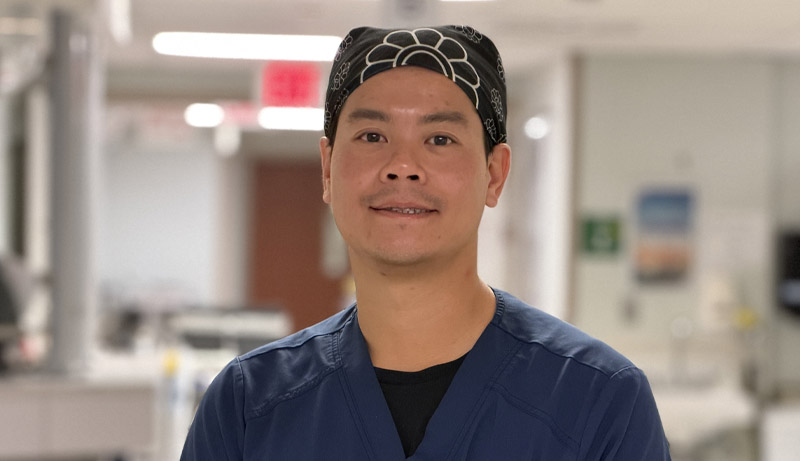
For Emergency Department nurse Khai T., RN, great care is about more than treating an illness or injury. It’s about seeing the person behind the patient and doing what he can to help them feel cared for.
For Shore Medical Center Emergency Department nurse Khai T., RN, caring for a patient doesn’t end when the immediate medical problem has been addressed. It means thinking about what happens next: Does the patient have somewhere safe to go? Do they have someone to help them? Do they understand what they need to do after discharge? Is there something happening in their life that could bring them right back to the Emergency Department?
“To me, caring means going beyond what’s expected of your job and doing whatever it takes to make sure the patient has what they need,” Khai said. “That’s one of the reasons I love it here at Shore. We try to make everything right for the patient before discharge.”
It’s an approach Khai has seen throughout Shore, particularly when caring for patients whose needs extend beyond the reason that brought them to the Emergency Department. Shore’s team may involve social workers and other resources to understand what is preventing someone from staying well or what support they may need to return home safely.
“We keep trying,” Khai said. “We don’t give up here.”
Khai remembers one young woman visiting the United States who was brought to Shore after being found alone in Atlantic City. She didn’t speak English and had lost her phone, her wallet and anything else that could help her get back to the family she was visiting. Once Khai knew she was medically safe, his focus turned to making sure she had somewhere safe to go.
Working through Shore’s translation services, Khai went to great lengths to locate her family so she could safely return to them. It took a lot of creative problem solving, but for Khai, it was simply another part of caring for the person in front of him.
Trusting His Instincts
That determination also shapes the way Khai advocates for patients clinically. He remembers a piece of advice from Shore Emergency Department physician William Schumacher, DO, who encouraged him to trust his training, pay attention to his instincts and speak up when something doesn’t seem right.
Khai remembers caring for a patient who arrived with a severe headache that felt different from migraines she had experienced previously. Her blood pressure was also unusually high, and Khai was concerned. He communicated what he was seeing to the care team and advocated for further evaluation.
Testing revealed a very serious condition requiring transfer to a higher level of care.
For Khai, the experience reinforced something he values about Shore’s Emergency Department: Nurses are encouraged to pay attention, communicate concerns and advocate for their patients as part of a collaborative care team.
“If you’re advocating for the patient for the right reasons, people support you,” he said.
Experiencing Shore as a Family Member
Khai has spent years caring for other people’s family members in Shore’s Emergency Department. More recently, he found himself on the other side of that relationship when his own mother became ill.
Although she didn’t want to go to the hospital, Khai encouraged her to come to Shore, where she was evaluated and admitted. Once she left the Emergency Department and continued her care on one of Shore’s inpatient units, Khai had to do something that isn’t always easy for a nurse: step back and trust his colleagues to take care of someone he loved.
He remembers meeting the nurse who cared for his mother and hearing about the attention she received throughout her stay. His mother’s own assessment made him smile when she described Shore as “a hotel with healthcare.”
For Khai, however, the experience provided something even more important: reassurance.
“I knew they were going to take care of her,” he said.
He didn’t feel that he had to remain at his mother’s bedside watching over every detail. As a Shore nurse, he knew the people caring for her. As her son, he experienced firsthand what it felt like to place that trust in them.
When the Caregiver Needed Care
Khai has also experienced Shore’s culture of caring in a deeply personal way. After the loss of his brother and another significant family loss, Khai and his wife had been through an extraordinarily difficult period and needed time away.
Khai approached his director, Sherri R., MSN, RN, EMT, knowing that the amount of time he hoped to take might be difficult to accommodate. He was prepared for the possibility that he would need to leave his position and try to return later. Instead, Sherri advocated for him and helped make it possible for him to take the extended time he needed.
“I’ve worked in a lot of places. I’ve been in the military. I’ve worked for other companies,” Khai said. “I’d never had a job do something like that for me. It was nice to work somewhere where you feel cared for, too.”
Khai spent six months in Japan, giving himself and his wife an opportunity to reset. He expected to welcome the break from nursing, but about three months into his time away, he noticed something he hadn’t anticipated: He missed the bedside.
“I thought I’d love having the break, but I missed it,” he said. By the time he was preparing to return home, Khai was eager to get back to Shore.
Finding His Way to Nursing
Nursing wasn’t Khai’s first career. He served eight years in the U.S. Air Force working in civil engineering, where his responsibilities included rebuilding and maintaining airfields, parking areas and other infrastructure.
Although he enjoyed his military service, Khai knew engineering wasn’t where he wanted to spend his career. “I needed something more,” he said.
While serving in the Reserves, Khai began working as an EMT. Working alongside nurses and caring for patients helped him realize that nursing could be his next step. His EMT work and nursing education also exposed him to different emergency departments and different approaches to care – including Shore.
What stood out about Shore, he said, was how personal the care felt and how much attention was paid to what patients needed beyond the immediate emergency. Today, Khai isn’t sure where his nursing career will eventually take him, but he knows “the ER definitely has a big hold on me.”
One Patient at a Time
As much as Khai loves nursing, he readily acknowledges that there are difficult days. There are shifts when he goes home exhausted and wonders whether everything he did was enough. That’s why the comments he receives from patients and families carry so much weight.
One Shore nurse whose family member was cared for by Khai told Emergency Department leadership that watching him care for her loved one restored her faith in the nursing profession and in the next generation of nurses.
“It means the world, honestly,” Khai said. “Nursing isn’t an easy job, and it’s not for everyone. So when you get those little reminders that you’re doing what you’re supposed to do and people actually appreciate it, it boosts you back up.”
Sherri once encouraged him to keep a binder of those comments so he could return to them after a difficult day. Khai took her advice. “It reminds you why you’re doing this,” he said.
That sense of responsibility sometimes follows him home. Khai admits there have been times when, while driving home after a shift, he has replayed his day and wondered whether he remembered to communicate something. When that happens, he calls the Emergency Department to make sure the next nurse received a piece of information he was worried about.
Ultimately, Khai hopes his patients remember something much simpler than any individual thing he did for them.
“I hope they leave knowing that people in healthcare really do care,” he said.
Khai knows some people arrive at a hospital frightened, skeptical or simply unsure of what to expect. When asked what he would tell someone in the community who doesn’t know Shore or hasn’t experienced the hospital for themselves, he points to the people inside it.
“People who come through this hospital tell us, ‘You’re doing something different here,’” he said. “We’re so much more than just a community hospital.”
For Khai, the best way to understand that difference is to experience it.
“You’ll realize that at Shore, we truly live the mission,” he said. “We really care.”